
Metabolic health · 17 September 2026 · 7 min read
What Is Insulin Sensitivity? Plain English, Limits and Questions for Your Clinician
A plain-English concept overview, limits of online explanations, and questions for a clinician.
By PeakSpan Health
“Insulin sensitivity” appears often in social posts about metabolism, energy and blood glucose. In clinical and research language, it describes how effectively the body’s tissues respond to insulin. Lower sensitivity is often discussed as insulin resistance. Neither phrase, on its own, is a full diagnosis of diabetes or a personal treatment plan.
This article sits beside what metabolic health actually means. The aim is literacy: what the concept usually refers to, where popular explanations oversimplify, and what is worth discussing with a clinician.
What does insulin sensitivity mean in plain English?
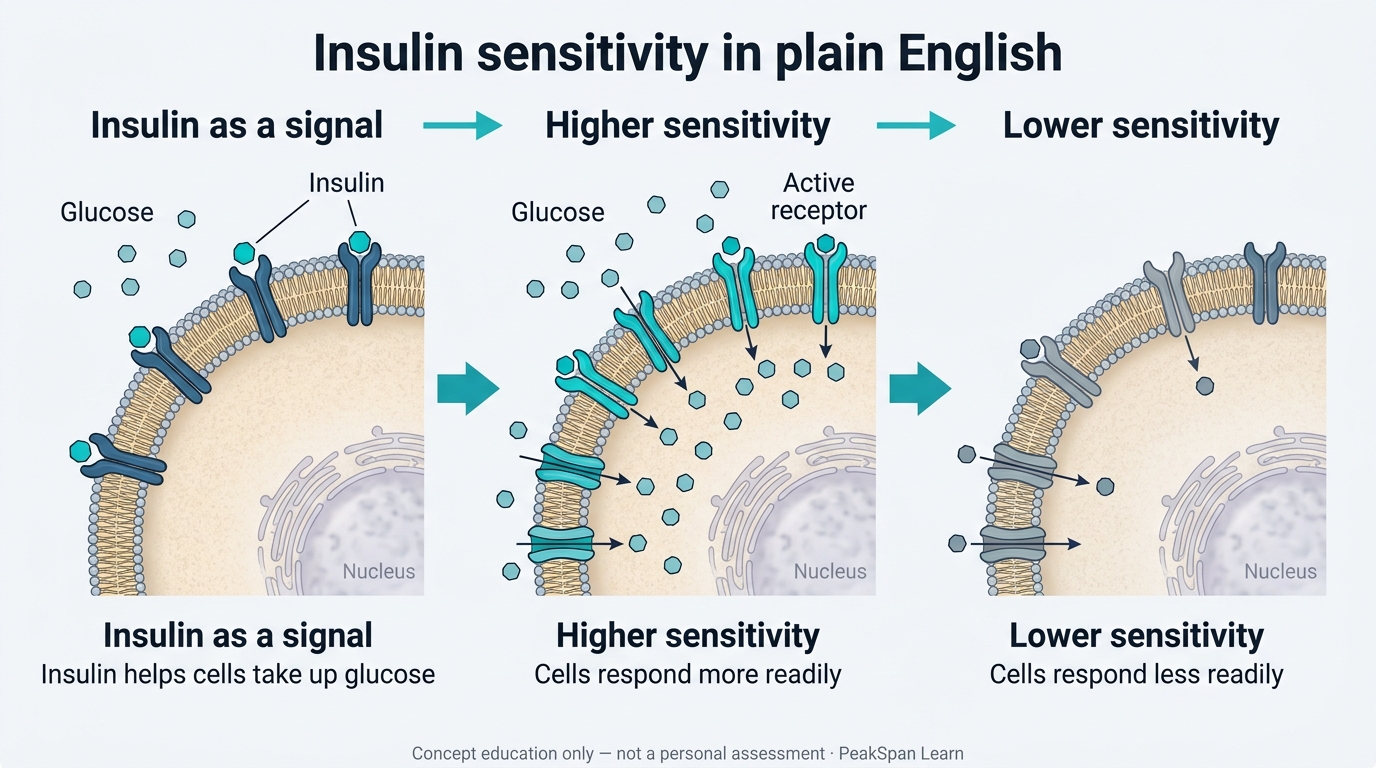
Insulin is a hormone that helps glucose move from the blood into tissues such as muscle and liver. When tissues respond well, less insulin may be needed to manage a given glucose load. When tissues respond less well, the body may need to produce more insulin to achieve a similar effect. That reduced response is commonly described as lower insulin sensitivity or insulin resistance.
These are educational descriptions of a process. They are not a label you should assign to yourself from a single wearable reading or a short online quiz.
Why do social media explanations often oversimplify?
Popular posts often treat insulin sensitivity as a single dial that is either “fixed” or “broken”, then attach a product, protocol or dramatic promise. Real physiology is broader. Sleep, illness, medicines, body composition, activity patterns and other conditions can all sit in the same conversation. Research definitions also differ between studies.
A binary online label can hide detail in the same way that a simple “metabolically healthy or unhealthy” tag can. Context matters more than a slogan.
Which related ideas are easy to confuse?
People often mix several concepts:
- a short-term rise in blood glucose after a meal
- fasting glucose or longer-term markers discussed in clinic
- “metabolic health” as a cluster of measurements rather than one score
- body weight or waist measurement as related but separate information
A glucose change after eating is not automatically the same thing as a clinical judgement about insulin sensitivity. AIHW discusses high blood glucose and related biomedical risk factors as population health topics, not as a consumer self-rating system.
What measurements might be discussed clinically?
In everyday care, clinicians more often discuss glucose-related tests, lipids, blood pressure, waist measurement and overall history than a specialised research measure of insulin sensitivity. Research methods such as clamp studies are generally not routine clinic tools.
Some blood markers and calculated indices appear in research or selected clinical contexts. This article will not interpret your labs, name a personal target, or suggest a DIY panel. If a clinician mentions a measurement, ask what question it is helping them answer for you.
Which lifestyle themes appear in education without becoming a protocol?
Public health and diabetes education commonly discuss sleep, physical activity and eating patterns as topics that relate to metabolic health over time. That is different from prescribing a personal plan in an article.
At literacy level only:
- activity and muscle use are often discussed in relation to how tissues handle glucose
- dietary patterns are discussed as patterns over time, not as one meal “fix”
- sleep and illness can change day-to-day readings
None of that is a training plan, meal protocol, dosing guide or product recommendation. Individual advice needs a qualified professional who knows your history.
What questions are worth taking to a clinician?
Helpful questions can include:
- What does “insulin sensitivity” mean in my situation, if anything?
- Which measurements are relevant for me, and which are not needed right now?
- How should I read a change over time rather than one result?
- What lifestyle topics are highest priority for my circumstances?
- When would further assessment for diabetes or related conditions be appropriate?
Bring previous results if you have them. Avoid starting or stopping medicines based on an article or a social post.
What are the limits of this explanation?
There is no single consumer definition of insulin sensitivity that replaces clinical assessment. Popular explanations often skip uncertainty, individual variation and the difference between research tools and routine care. This article cannot diagnose insulin resistance, diabetes or any other condition, and it does not recommend treatments, products or access routes.
References
- Australian Institute of Health and Welfare. Biomedical risk factors. Checked 17 September 2026.
- Luca A. Lotta, Ali Abbasi, Stephen J. Sharp, Anna-Stina Sahlqvist, Dawn Waterworth, Julia M. Brosnan, Robert A. Scott, Claudia Langenberg and Nicholas J. Wareham. “Definitions of Metabolic Health and Risk of Future Type 2 Diabetes in BMI Categories: A Systematic Review and Network Meta-analysis.” Diabetes Care. 2015;38(11):2177-2187. DOI.
- NIDDK (US National Institute of Diabetes and Digestive and Kidney Diseases). Insulin Resistance & Prediabetes. Educational overview of insulin resistance and related glucose testing in clinical care. Checked 17 September 2026.
This article provides general education about a metabolic concept. It is not medical advice, does not interpret personal results and does not recommend products, protocols or treatments.
Information checked: 17 September 2026