Evidence · 17 September 2026 · 6 min read
Absolute Versus Relative Risk: A Practical Checklist for Reading Health Headlines
Why big percentages can mislead, how absolute risk differs, and a short checklist before you act.
By PeakSpan Health
Health headlines often lead with a percentage. “Risk doubled” or “cut by half” can be true in a narrow statistical sense and still leave out the information most readers need: how common the outcome was to begin with, and how many people were affected in each group.
This article complements how to read health research without being misled. Here the focus is one framing problem: absolute versus relative risk.
Why can relative risk percentages sound bigger than the real-world change?
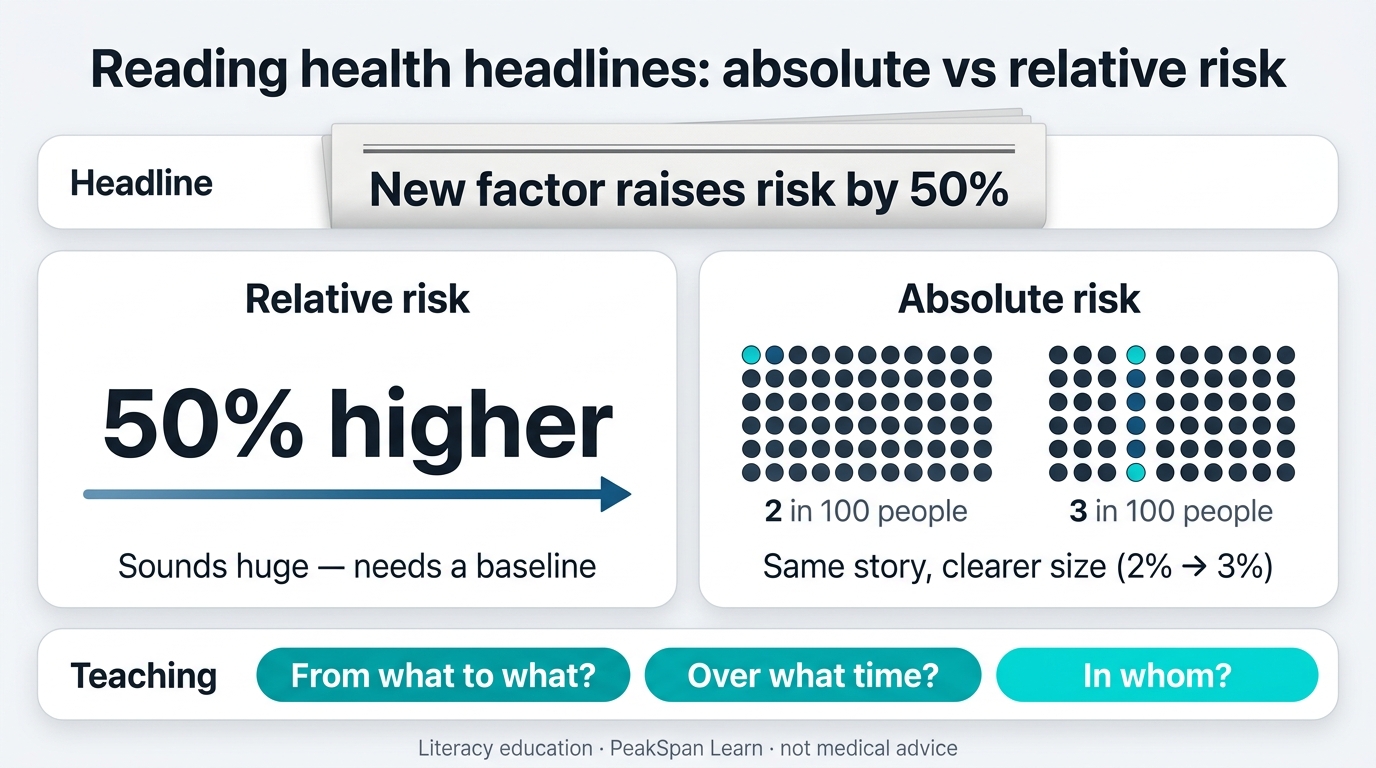
Relative risk compares one group with another as a ratio or percentage change. If an outcome is uncommon, a large relative change can still mean a small change in the number of people affected.
An older NHMRC handbook on preparing consumer publications recommended usually presenting absolute risk. The point was communication clarity: readers need the size of the effect in everyday terms, not only a dramatic relative figure.
What does absolute risk add that relative risk leaves out?
Absolute risk describes how many people in a group experienced the outcome, or how much that number changed. It restores the missing denominator.
In plain terms, ask:
- How common was the outcome in the comparison group?
- How common was it after the exposure, treatment or difference being discussed?
- How many people would need to be considered for one extra outcome to appear or be avoided?
Without those anchors, a headline percentage is incomplete.
How do worked examples make the difference clearer?
The following numbers are illustrations only. They are not claims about a real disease, product or study.
Illustration A. Imagine 2 people in every 1,000 in Group A experience an outcome, and 3 people in every 1,000 in Group B experience it. A relative framing might say risk rose by 50%. An absolute framing says there was 1 extra outcome per 1,000 people.
Illustration B. Imagine 200 people in every 1,000 in Group A experience an outcome, and 300 in every 1,000 in Group B. The relative rise is also 50%, but the absolute difference is 100 extra outcomes per 1,000 people.
Same relative percentage. Very different practical scale. That is why absolute numbers matter before anyone treats a headline as decision-ready.
What checklist helps before you act on a health claim?
Use a short reading check:
- Study design: Was this a lab note, observational study, trial or review?
- Who was studied: Age, health status and setting; can the result apply to you?
- Sample and timeframe: How many people, and for how long were they followed?
- Absolute numbers: What happened in each group, not only the relative percentage?
- Uncertainty: Are confidence intervals, limitations or conflicting studies mentioned?
- Conflicts and funding: Who paid, and what did authors declare?
A claim can be statistically significant and still be too small, too uncertain or too specific to guide a personal decision.
What should you do with uncertainty?
Do not start, stop or change a treatment from a headline alone. If a claim worries you or seems relevant to your care, take the original source questions to a qualified health professional. They can help weigh absolute risk, your history and current guidelines.
Seek urgent care for emergency symptoms rather than waiting on a news cycle.
What are the limitations of this article?
Risk framing literacy cannot replace clinical advice. Illustrations are simplified. Real studies include bias, missing data, surrogate outcomes and populations that may not match yours. One article cannot validate every headline you will see.
References
- National Health and Medical Research Council. How to Present the Evidence for Consumers: Preparation of Consumer Publications. 2000 (endorsed November 1999). Checked 17 September 2026.
- PeakSpan Health. How to Read Health Research Without Being Misled. Companion literacy article.
This article provides general education about risk framing in health communication. It is not medical advice and does not recommend treatments or interpret a personal risk score.
Information checked: 17 September 2026