
Healthy ageing · 17 September 2026 · 7 min read
Strength Training After 40: Progressive Overload, Evidence Limits and When Assessment Helps
Why strength work still matters after 40, how progressive overload fits, and when assessment helps.
By PeakSpan Health
Resistance training remains relevant well beyond early adulthood. Muscle, strength and physical function matter for daily life, confidence and healthy ageing. That does not mean every 40-plus adult should follow the same plan, or that online templates can replace judgement when pain, illness or long layoffs are involved.
This article sits beside resistance training and healthy ageing. Here the lead question is strength training after 40, with progressive overload explained as a concept and assessment flagged when the next step is unclear.
Why does strength training after 40 still matter?
Public health guidance treats muscle-strengthening activity as part of adult health, not only a pursuit for younger athletes. The World Health Organization recommends muscle-strengthening activities involving major muscle groups on two or more days each week for adults and older adults. Older adults are also advised to include activity that emphasises balance and strength.
For many people in midlife, the practical reasons are functional: carrying shopping, climbing stairs, staying robust for sport or work, and maintaining the capacity to keep training. Literacy, not fear, is the useful frame. Ageing changes capacity; it does not automatically forbid progress.
What is progressive overload in plain English?
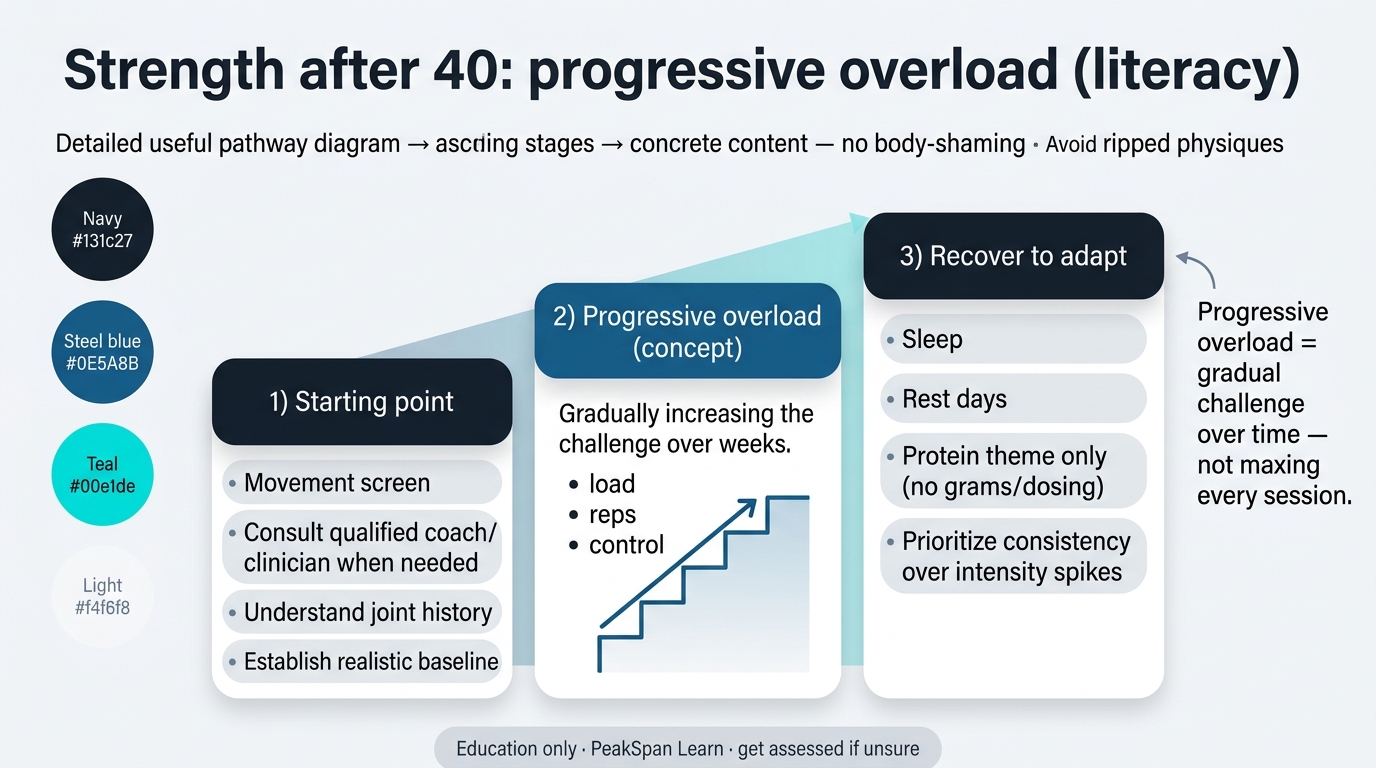
Progressive overload means gradually increasing the demand on muscles over time so the body has a reason to adapt. Demand can rise through load, repetitions, sets, range, control or session frequency. It is a training principle, not a dare to add weight every session.
After 40, the same principle still applies, but the rate of progression usually needs to respect recovery, joint comfort and training history. Small, repeatable increases often matter more than dramatic jumps. This article does not prescribe percentages, set schemes or a personal programme.
What commonly changes with age?
Recovery between hard sessions may take longer for some people. Tendons and other connective tissues can be less tolerant of sudden spikes in load. Previous injuries, medicines, sleep and stress also shape what a sensible next step looks like.
These are general patterns discussed in exercise and rehabilitation education. They are not predictions for any one reader. Some adults progress quickly; others need a slower runway. Individual variation is expected.
What does the evidence support, and where are the limits?
Evidence reviews in older adults often favour resistance training for strength and functional performance compared with doing less. Effect sizes, programme details and participant groups differ between studies. Findings about muscle mass, for example, are not always as consistent as findings about strength.
A programme that helped a study group is not proof it is ideal for you. Study participants may differ in age band, health status, supervision and equipment. Publication bias and mixed methods also limit certainty. For a broader evidence snapshot in older adults, see our resistance training article.
When does assessment help?
Seek advice from a qualified health or exercise professional before pushing into demanding training if you have:
- current pain that changes your movement
- recent injury, surgery or unexplained weakness
- a health condition that affects exercise safety
- a long layoff with uncertainty about where to start
- repeated setbacks when you try to progress load
Assessment is not a failure of independence. It is how load, technique and red flags get matched to the person. Sudden severe symptoms need timely medical care, not a programme tweak from an article.
What questions can you ask a coach or clinician?
Useful prompts include:
- What is a sensible starting level given my history?
- How should I progress load without ignoring warning symptoms?
- Which aches are common training discomfort, and which need review?
- How should recovery days fit around work, sleep and other training?
- Do I need a clinical review before coaching progresses further?
Link this conversation with related literacy on protein and maintaining muscle and why tendon injuries can take time to heal when those topics arise. Literacy links are not treatment plans.
What are the limitations of this guide?
No article can prescribe a safe programme for every adult over 40. Evidence summaries mix different ages, settings and outcomes. This piece does not diagnose injury, promise performance outcomes or replace physiotherapy, medical or accredited exercise advice.
References
- World Health Organization. WHO guidelines on physical activity and sedentary behaviour. 2020.
- Meiling Tao, Kaifang Liao, Mingyue Yin, Zhili Chen, Yuming Zhong, Chenwen Zhu, Yuou Song, Steve Thompson, Chris Bishop and Yongming Li. “Effects of Maximal Versus Submaximal Intended Velocity Resistance Training on Muscular Fitness Adaptations in Older Adults: A Systematic Review and Meta-analysis.” Sports Medicine and Health Science. 2026;8(4):365-376. DOI.
This article provides general health and training literacy. It does not prescribe an exercise programme or account for injury, symptoms or individual health needs.
Information checked: 17 September 2026