
Health checks · 17 September 2026 · 6 min read
Blood Test Preparation: Fasting vs Non-Fasting and Why Context Matters
General preparation first, then how fasting instructions can change some results, and why context matters.
By PeakSpan Health
Blood tests can help answer specific questions. They are easier to interpret when preparation matches what the ordering clinician and laboratory expected. Fasting is one common instruction. It is not the only one that matters, and it does not apply to every test.
This guide complements our article on what common blood tests can and cannot tell you. Here the focus is preparation literacy: what to clarify beforehand, how fasting usually differs from a non-fasting collection, and why a single number is not a verdict.
How should you prepare for a blood test in general?
Follow the written instructions from the clinician or collection centre that ordered the test. If those instructions conflict with something you read online, ask the ordering clinician or the collection service before changing your routine.
In general education terms, people are often asked to:
- confirm the appointment time and any special instructions
- bring identification and any forms the clinic requested
- note current medicines and supplements, because some can affect results or timing
- stay hydrated with water unless you have been told otherwise
- avoid rearranging medicines on your own unless your clinician has given clear advice
Healthdirect emphasises that results only have meaning in context, including why the test was ordered and how you prepared.
What does “fasting” usually mean in lab instructions?
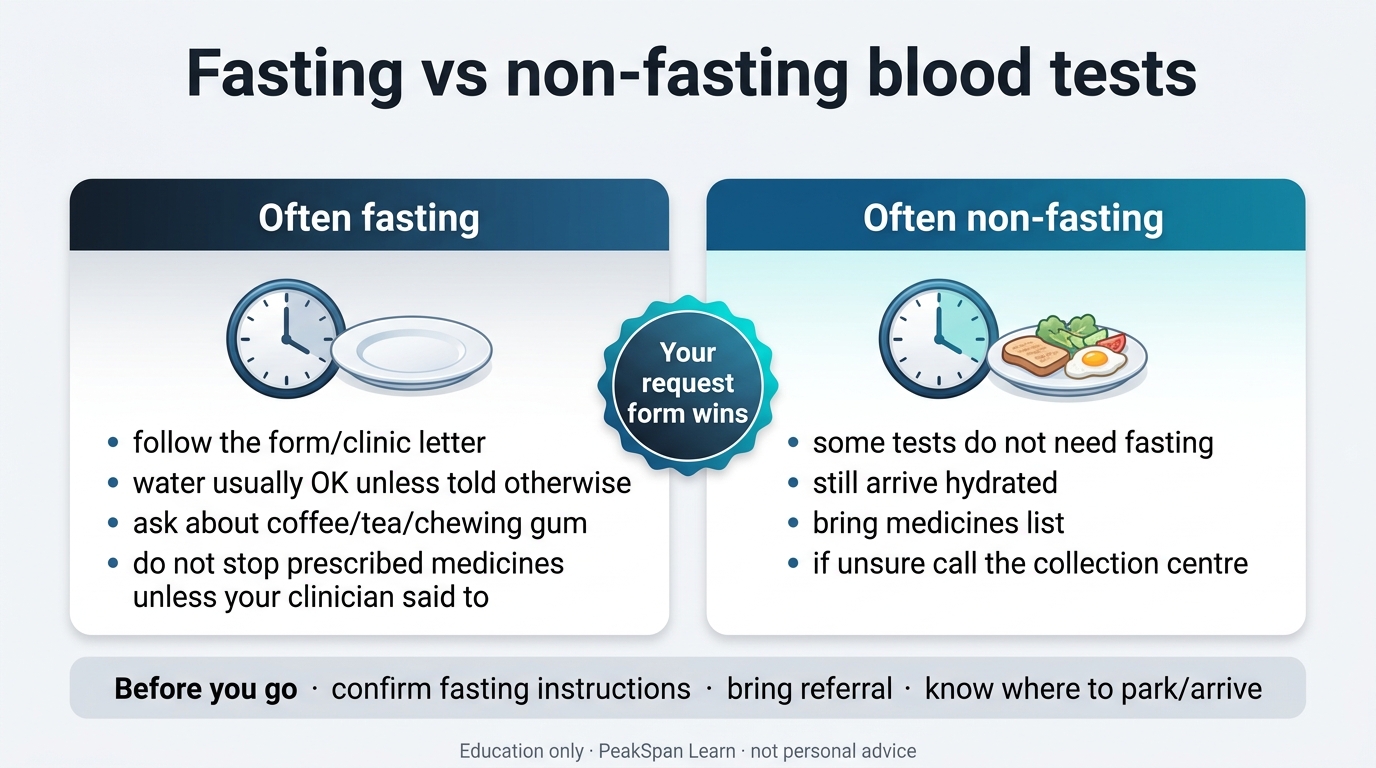
In many Australian collection settings, fasting for blood work commonly means no food for a defined period before the sample, while water is often still allowed. Exact timing and rules can differ by test and by laboratory. Some instructions also limit chewing gum, smoking or vigorous exercise beforehand.
This article cannot set a personal fasting schedule. If your form says “fasting” and you are unsure what is allowed, contact the collection centre or ordering clinician before the appointment.
How do fasting and non-fasting collections differ?
Some blood measurements are more sensitive to recent food intake than others. Glucose and some blood fat measurements are classic examples where laboratories and population surveys often specify fasting conditions. Other tests are routinely collected without fasting.
At a literacy level:
- fasting status can change how some results are compared with reference information
- a non-fasting sample is not automatically “wrong”; it may be exactly what was intended
- mixing a fasting result with a non-fasting comparison can create confusion
The Australian Bureau of Statistics National Health Measures Survey, for example, presents some glucose and lipid findings only for people who fasted for a defined period before the blood test. That survey context is population research, not your personal report. It does illustrate why laboratories and clinicians care about preparation notes on the request form.
Why is a single number not a verdict?
A result sits beside the reason for the test, your history, medicines, recent illness, timing and previous values. Healthdirect notes that false positive and false negative results can occur, and that preparation, timing and illness may affect interpretation.
Trends over time often matter more than one isolated figure. Two people with the same number can have different clinical stories. Online comparison charts may also use different units or ranges from the laboratory that processed your sample.
What questions are worth asking the ordering clinician?
Useful preparation questions include:
- Do I need to fast for this test, and for how long?
- Can I take my usual medicines beforehand?
- Should I avoid exercise, alcohol or specific foods the day before?
- What question is this test meant to help answer?
- How will I receive the result, and who will explain it?
Ask these before the collection if you are unsure. After the result, ask what changed, what stayed the same, and whether any follow-up is needed.
What can this article not do?
It cannot order tests, interpret your personal results, set target ranges, or recommend products or protocols. It also cannot tell you to start, stop or change a medicine. Those decisions belong with a qualified health professional who knows why the test was requested.
References
- Healthdirect Australia. Guide to blood testing. Last reviewed March 2025; checked 17 September 2026.
- Australian Bureau of Statistics. National Health Measures Survey, 2022–24. Checked 17 September 2026.
- Australian Institute of Health and Welfare. Biomedical risk factors. Checked 17 September 2026.
This article provides general health information about blood test preparation. It does not interpret a result, recommend a test panel or diagnose a condition. A qualified health professional can advise what preparation and results mean in your circumstances.
Information checked: 17 September 2026